
Technology
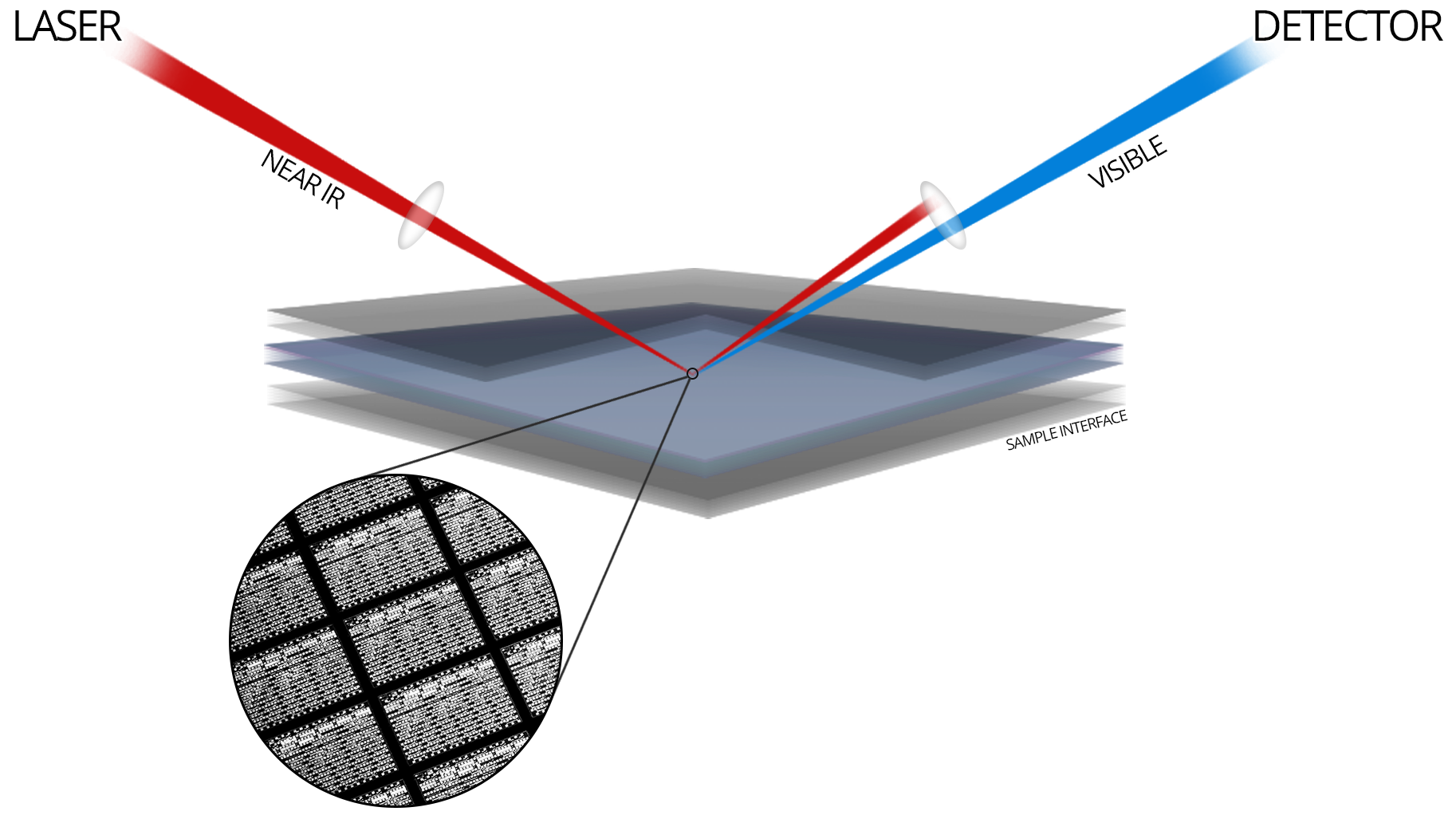
In the SHG process, two photons of one energy incident upon a sample material generate a single photon of twice that energy.
This process integrated over the many photons emitted from a laser source create a substantial number of doubled-energy photons,
which are detected as the SHG signal. The values and time dependence of the SHG signal contain information about the material system being tested.
SHG Process에서 sample material에 입사하는 one energy의 two photons는 energy의 두 배를 가진 a single photon을 생성합니다.
Laser source에서 방출되는 수 많은 광자에 통합된 이 Process는 상당수의 doubled-energy photons를 생성하며 이는 SHG signal로 감지됩니다.
SHG signal 값들과 time dependence는 test 되고 있는 Material system에 대한 정보를 담고 있습니다.
The Second Harmonic generated by laser irradiation occurs in places where symmetry in the material is broken,
such as at hetero-interfaces and various types of crystalline defects. In non-centrosymmetric materials, such as III-V,
Second Harmonic will also be generated from the bulk material.
Laser 조사에 의해 생성되는 Second Harmonic은 Hetero-interface 혹은 다양한 유형의 crystalline defects과 같이 material의 대칭성이 깨지는 곳에서 발생합니다.
Ⅲ-Ⅴ와 같이 non-centrosymmetric materials인 경우 bulk material에서도 Secone Harmonic이 생성됩니다.
Optical Second Harmonic Generation (SHG) is a non-destructive, contactless, optical characterization method for characterizing surfaces, interfaces, thin-films, as well as bulk properties of materials.
Optical Second Harmonic Generation(SGH)은 Surface, Interfaces, Thin-films은 물론 Materials의 Bulk properties을 특성화 하기 위한 비파괴, 비접촉식 Optical Characterization Method 입니다.
Second Harmonic Generation Overview
- Non-destructive surface+subsurface analysis
- High in-line throughput
- No sample preparation
- No consumables or reagents
- Non-contact optical technique
- Patterned and blanket wafers
Second Harmonic Generation Uses
- Charge trap density
- Strain/Stress
- Trace metal contamination
- Structural defects
- Critical dimension measurements
- Thin film quality
(Semicon Korea 2016, MI Forum)
(ASMC 2015)
Abstract - Time dependent second harmonic optical signals were measured across silicon-on- insulator (SOI) wafer coupons contaminated by Cu-63 ion implanted into the buried oxide (BOX) and near the SOI/BOX and BOX/Bulk interfaces. Average signals after 1 second of exposure for all spatial points were compared between wafers and used to differentiate contamination levels post ion-implantation.
(ISTFA 2015)
Non-destructive optical second harmonic generation (SHG) is shown to be an effective method for detecting surface and subsurface non-visual defects in commercial thick and extremely-thin(ET) SOI wafers. A method is demonstrated for removing contributions (noise) from layer thickness variations observed in thick SOI, increasing the sensitivity and enabling detection of trace surface metal contamination. Sub-surface contamination, otherwise missed by the standard flow of non-destructive characterization methods, is shown to be detected by SHG.
(ASMC 2018)
Substrate resistivity stability has become the most critical control for radio frequency (RF) device manufacturing. In this paper, we demonstrate nonlinear optics based metrology to measure electrically active oxygen interstitial sites (Oi) in high resistive bulk Si wafers, which are vulnerable to electric and mechanical property drift during device fabrication. Time dependent second harmonic generation (TD-SHG) governed by electric-field induced second harmonic (EFISH) effect provides consistent detection of thermal donors originating from Oi distributed near Si interface. The successful concept proof can be extended to test pad design for in-line monitor of substrate resistivity variations from annealing processes.


